The Spatial Museum
What happens when a museum experience understands not only what a visitor is looking at, but where they are standing, what surrounds them, and what they might want to discover next?
That question sat at the centre of a design discovery phase EyeJack undertook with the Australian Museum, using the Birds of Australia exhibition as a focused setting for exploring how AI and AR can enable more intelligent, spatially aware experiences that respond to the visitor, the collection and the room around them.
Spatial intelligence
Spatial intelligence is a broad term, but in the context of museums and visitor experience, it refers to technologies that can understand the space around a visitor, recognise what they are looking at, interpret visual information, and use that awareness to shape a more relevant and responsive experience.
For museums, that matters because interpretation is often constrained by space. A label can only say so much. An exhibition can only direct attention in so many ways. Visitors arrive with different ages, languages, interests and levels of prior knowledge. Some want the overview. Some want detail. Some want to find one very specific thing.
A spatial layer gives museums a new way to respond, helping each visitor find a path through the exhibition that feels more relevant to their interests, needs and level of understanding.
Why Birds of Australia?
At the Australian Museum, the Birds of Australia exhibition offers a compelling way to explore what spatial intelligence could mean in practice. Hundreds of species are represented across cabinets and dioramas, with stories spanning habitat, evolution, migration, behaviour, conservation and cultural significance.
The challenge is helping each visitor navigate the richness of the collection in a meaningful, personalised way and connect with the information that interests them most, whether they are looking for their favourite bird species, exploring a particular theme, completing a school activity or following their curiosity across the collection.
Spatial intelligence creates a new layer of access to those stories, helping visitors move through the exhibition with greater ease and confidence. It makes the collection more discoverable and allows each visitor to shape an experience around what matters most to them.
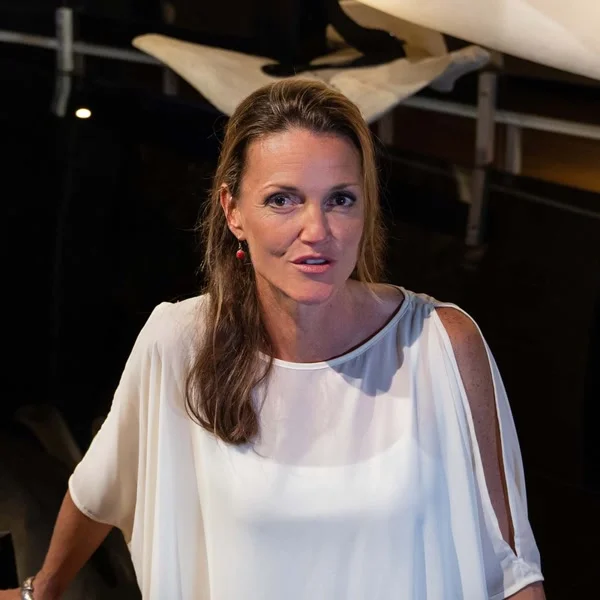
Fran DoreyHead of Exhibitions, Australian MuseumBirds of Australia provided an ideal opportunity to collaborate with EyeJack and explore how emerging technologies such as AI and augmented reality could support future museum experiences. It was a chance to investigate new ideas within the context of a real exhibition and explore the role they might play in future interpretation.
Conversational AI
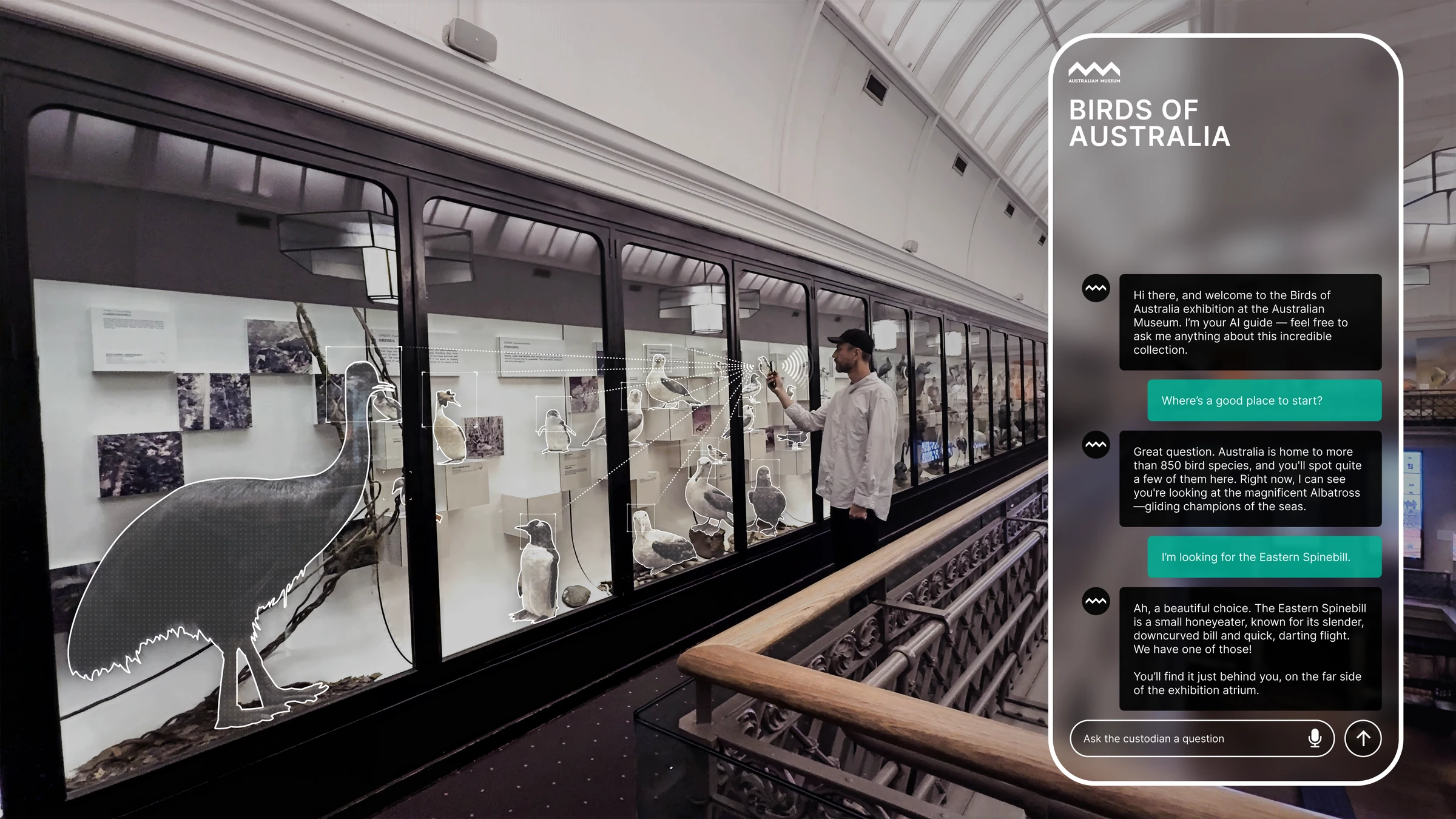
Conversational AI allows visitors to ask questions about the exact object in front of them. By pointing a phone at a display, they can ask whatever comes to mind, follow up on an answer, and let their curiosity shape where the conversation goes next.
The system combines visual recognition, awareness of the visitor's position within the exhibition, and the museum's own interpretive material to identify the object in view and connect it to the wider collection. Each response can guide the visitor towards related species, themes and displays across the exhibition.
A visitor looking at a Regent Bowerbird, for example, might ask why its plumage is so distinctive, learn about its courtship behaviour, then ask whether other bowerbirds behave in the same way. The guide could then direct them to a Satin Bowerbird elsewhere in the exhibition, turning a single question into a path through the collection.
The result is a more responsive and personal way to explore, with every interaction grounded in museum-approved knowledge and shaped by the visitor's own interests.
Spatial Search
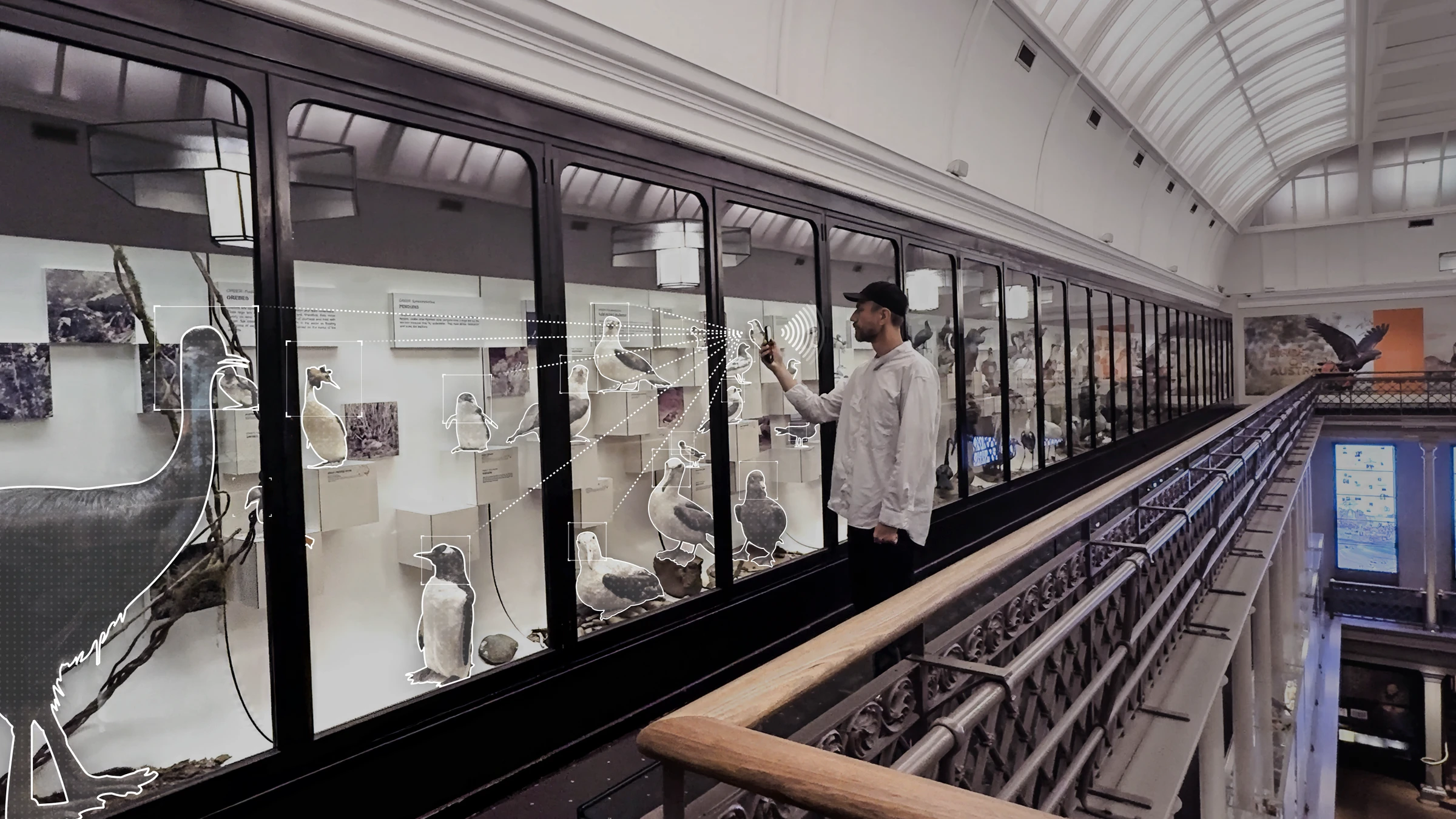
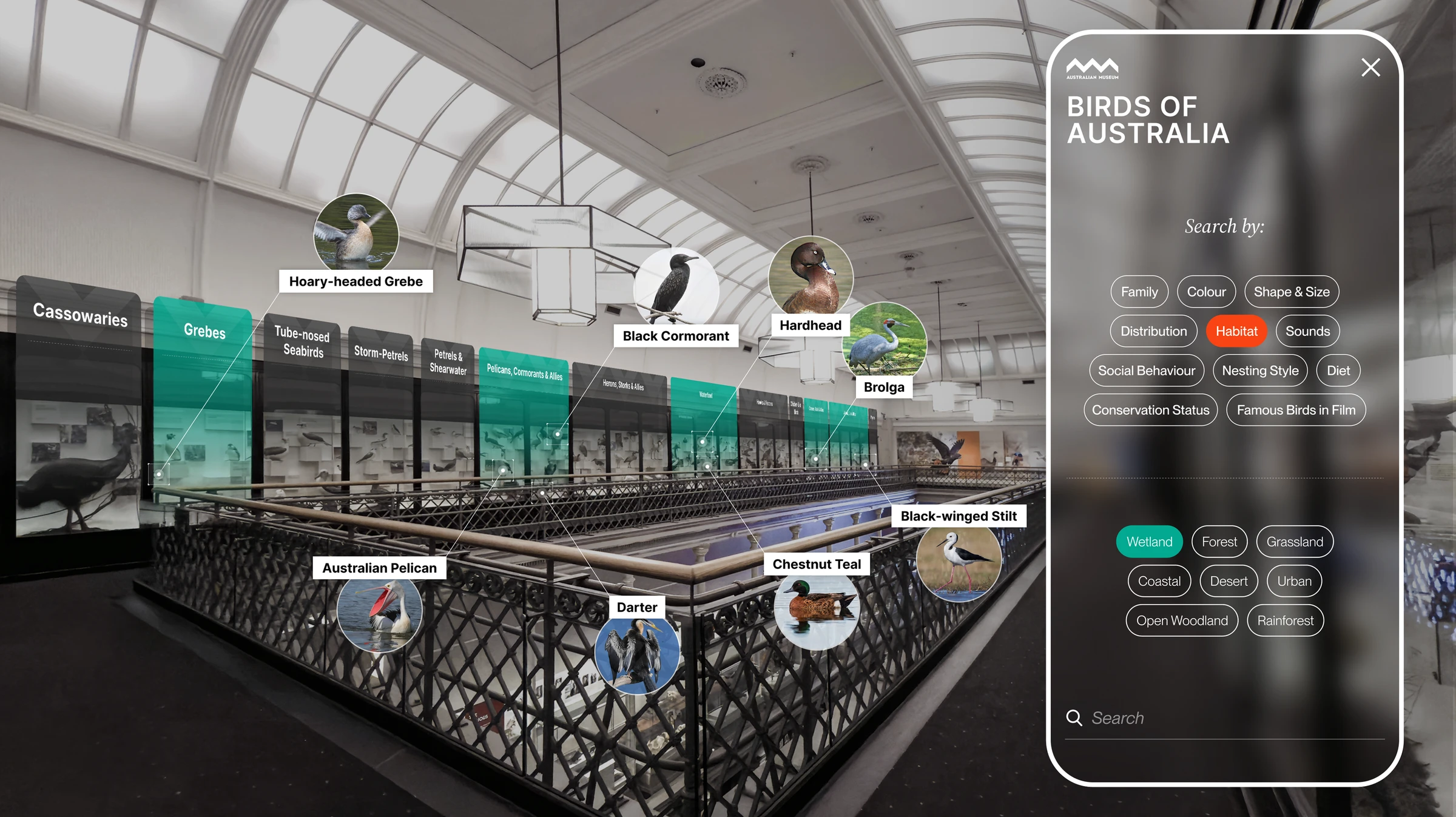
Spatial search gives visitors a more intuitive way to find objects across the exhibition. They might want to locate wetland birds, endangered species or birds of a particular colour. Rather than searching cabinet by cabinet, they can define their search criteria and see the exhibition respond around them.
Using augmented reality, a virtual information layer can be placed over the exhibition space. Individual bird species can be identified with floating labels, bird categories can be mapped across the exhibition to show how the collection is organised from a distance, and directional arrows on the floor can guide visitors towards their next point of interest.
This changes the nature of a self-guided visit. The exhibition is no longer experienced only through its physical layout, but can be temporarily reorganised around a visitor's interests. A student might look for species connected by habitat, a family might follow a trail of birds featured in films, and a more serious birder might move through the collection by taxonomy, conservation status or region.
The physical exhibition remains fixed, while the interpretive pathways through it become fluid.
Augmented Reality
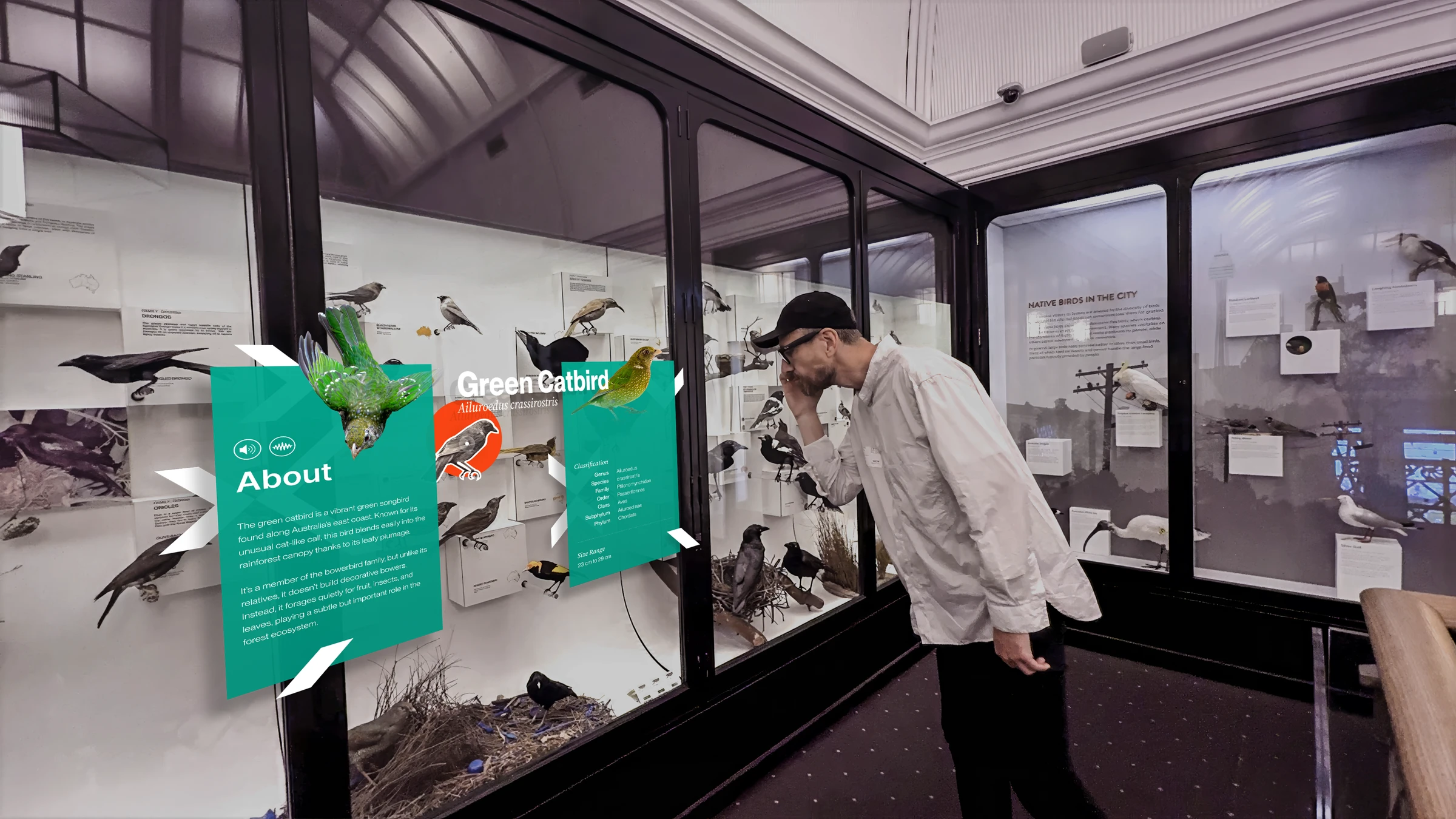
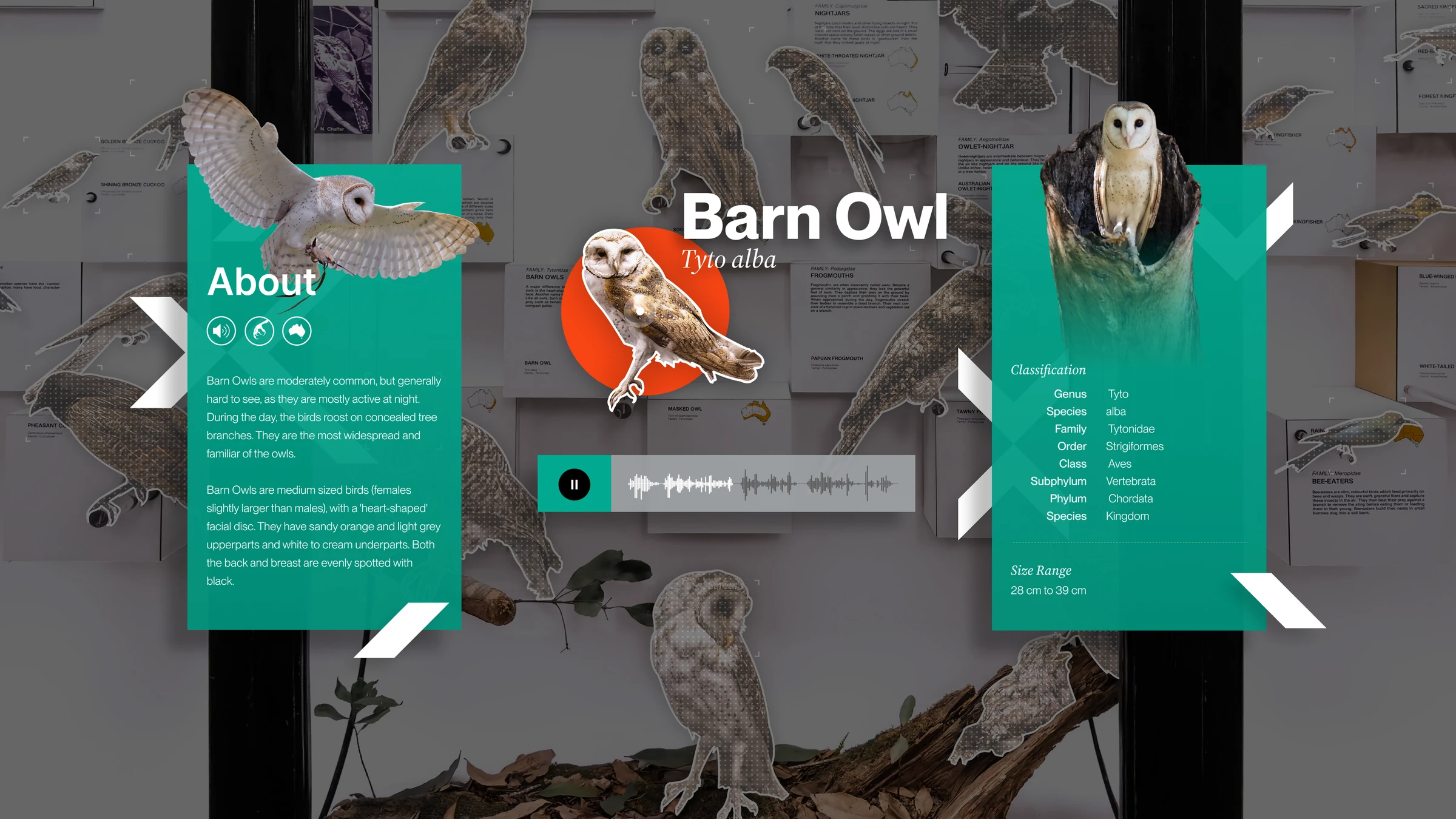
Augmented reality adds a deeper layer of interpretation around the object in front of the visitor. By selecting a bird through their phone, they can access footage of it in motion, recordings of its call, maps of its range and images of its habitat, all presented in direct relation to the specimen to help connect what they see in the cabinet with how the bird lives, moves and sounds in the world.
This allows interpretation to extend beyond the physical limits of the display. Where there may only be room for a label inside the cabinet, augmented reality creates space for richer layers of video, audio and visual content that provide a broader context around the object, while keeping the object itself as the central focus. It also opens up new creative possibilities for how digital content can respond to, build around and play off the physical object, creating more dynamic ways to communicate its story.
Smart Glasses
Smart glasses are an emerging form of wearable technology that is beginning to make its way into everyday consumer devices. Many already combine cameras, microphones and audio, allowing experiences to understand what the wearer is looking at, respond to natural voice questions and deliver information without requiring them to look down at a screen. Some devices also include augmented reality displays, placing virtual content directly over the wearer's view of the physical world.
For museums, this enables a more natural way of interacting with exhibitions. In the Birds of Australia exhibition, a visitor can simply look at a specimen and ask, “Where does this bird live?” or “Can I hear its call?” Directions can guide them to another species in the collection, while contextual information, images or animations can appear alongside the object at the moment they are most relevant. The experience becomes conversational, spatial and directly connected to the exhibition itself.
This changes the relationship between technology and the visitor experience. When the device is worn throughout the visit and becomes part of how the visitor sees, listens and interacts, digital interpretation is no longer a separate layer they consciously step into. It becomes increasingly integrated into the exhibition itself, creating new possibilities for conversational, contextual and highly personalised experiences across the museum.
While smart glasses are still an emerging platform and are not yet commonplace as everyday consumer devices, they already present an exciting opportunity for museums to create special exhibitions and events that give visitors a glimpse of where this technology is heading. EyeJack is continually exploring partnerships with leading hardware and technology providers to unlock these opportunities, helping cultural institutions experiment with the next generation of spatial visitor experiences while keeping the collection at the centre of the experience.